What's in a Parasend evidence pack, and is it admissible in court?
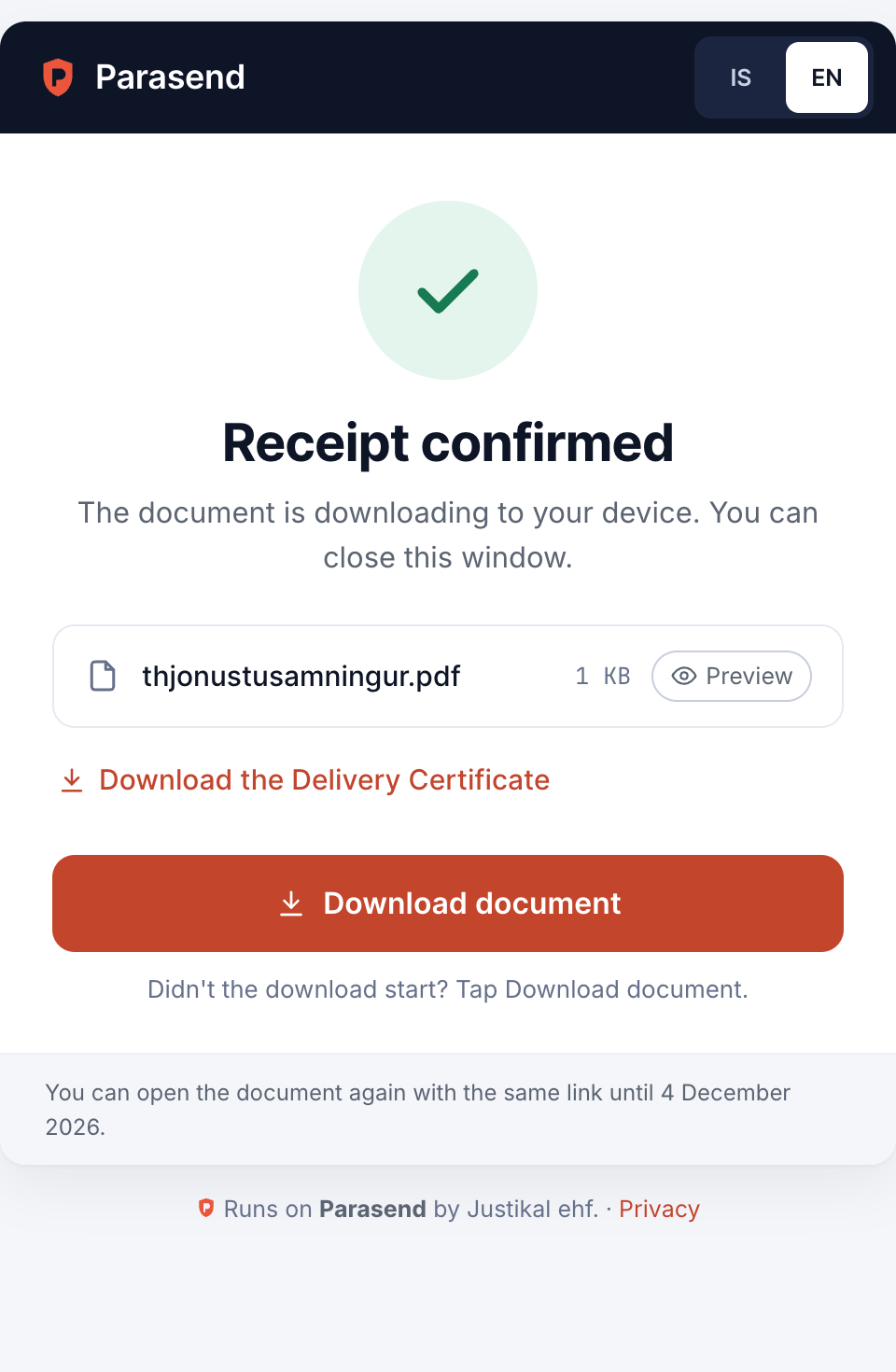
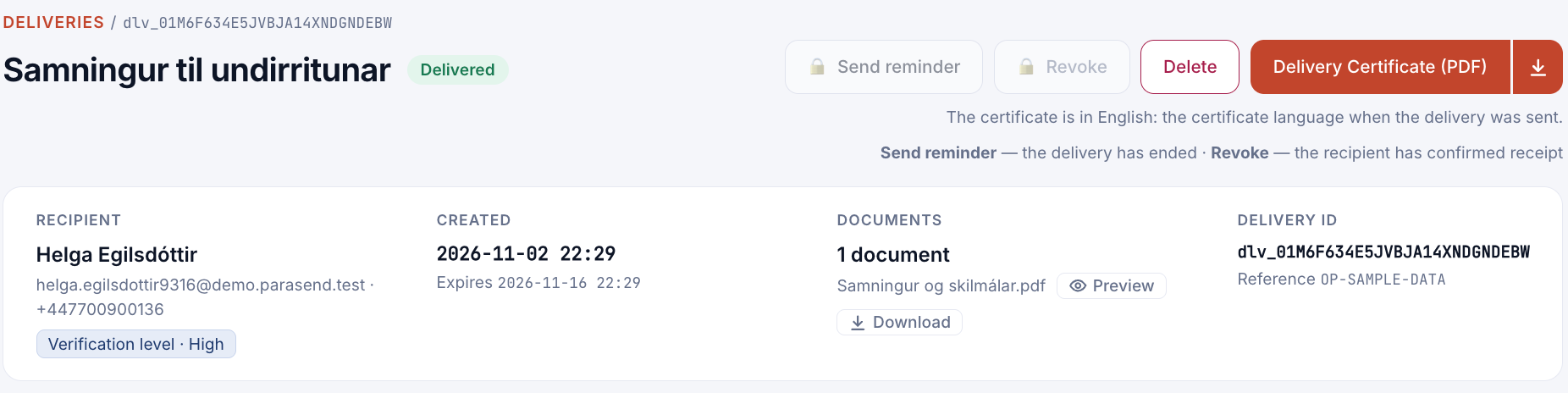
Every completed delivery produces a sealed evidence record and a human-readable PDF, available from the portal or the API (the PDF from GET /v1/deliveries/{id}/evidence/document, the sealed XML record from …/evidence/record). The pack includes the full event timeline - when the document was sent, when the recipient opened the verification link, which method they used to confirm their identity, and the exact moment they accepted receipt - together with a cryptographic seal and the recorded time of every event.
The evidence format follows ETSI EN 319 522, the registered-electronic-delivery standard EU regulators and courts recognise. Delivery evidence built to this standard, under eIDAS (Regulation (EU) 910/2014), can't be denied legal effect solely for being electronic (Art. 43). See What we hold ourselves to on the About page for exactly what's certified today.
If you're preparing a matter for a Nordic court or enforcement authority, the evidence PDF is designed to be handed over as-is; the underlying sealed record is also available for a technical or forensic review if one is requested.
Setting up automatic follow-up reminders for unopened deliveries
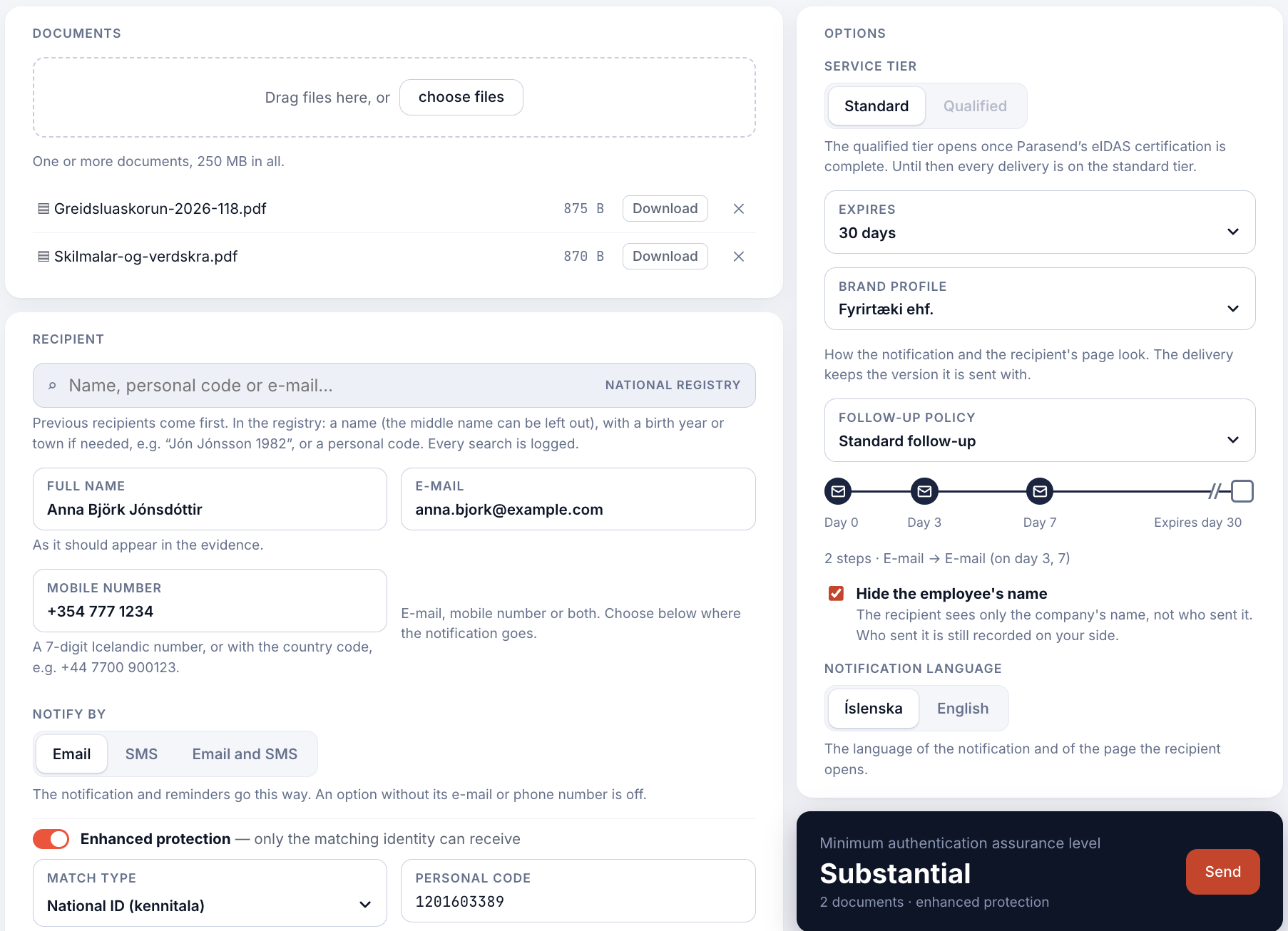
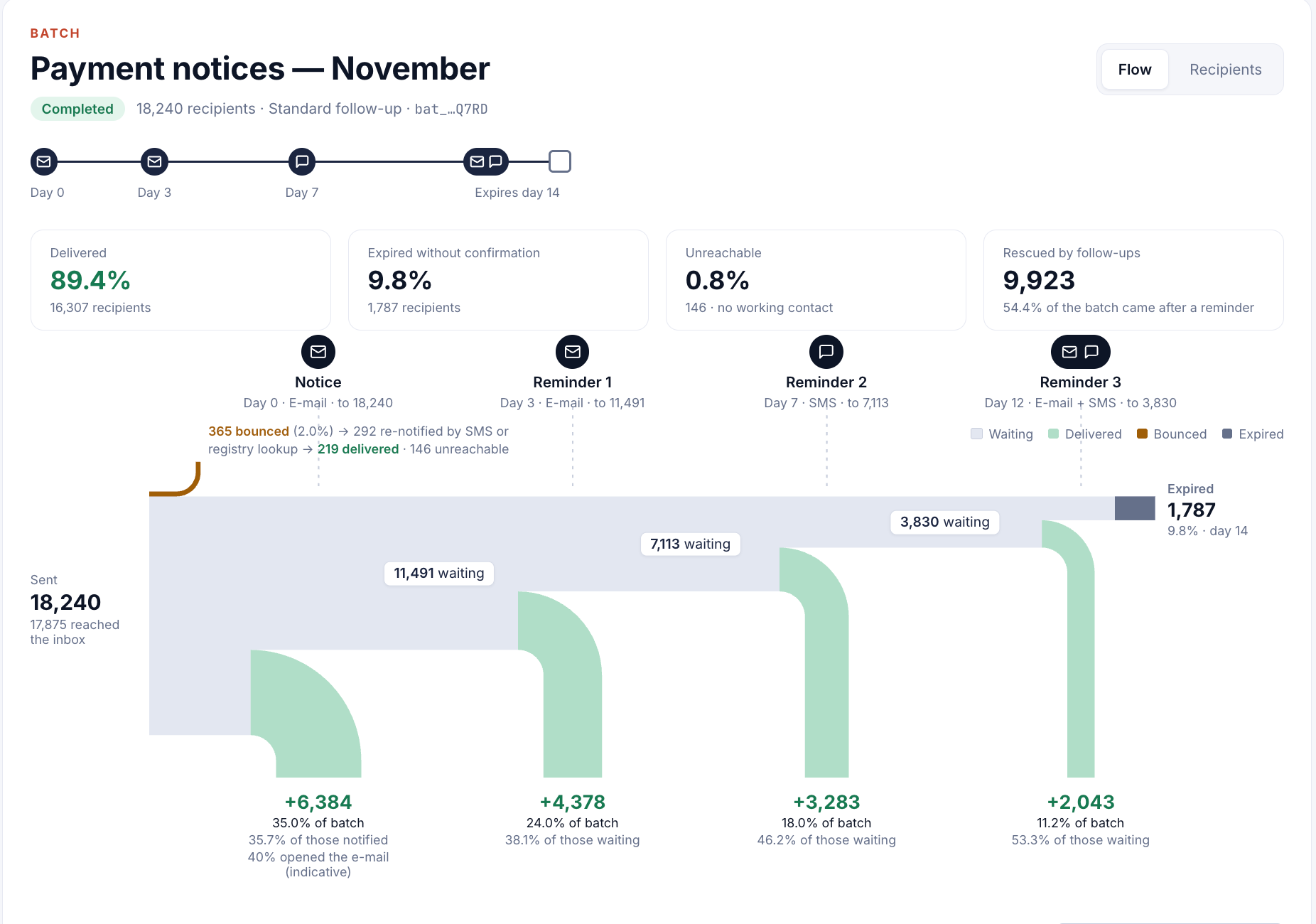
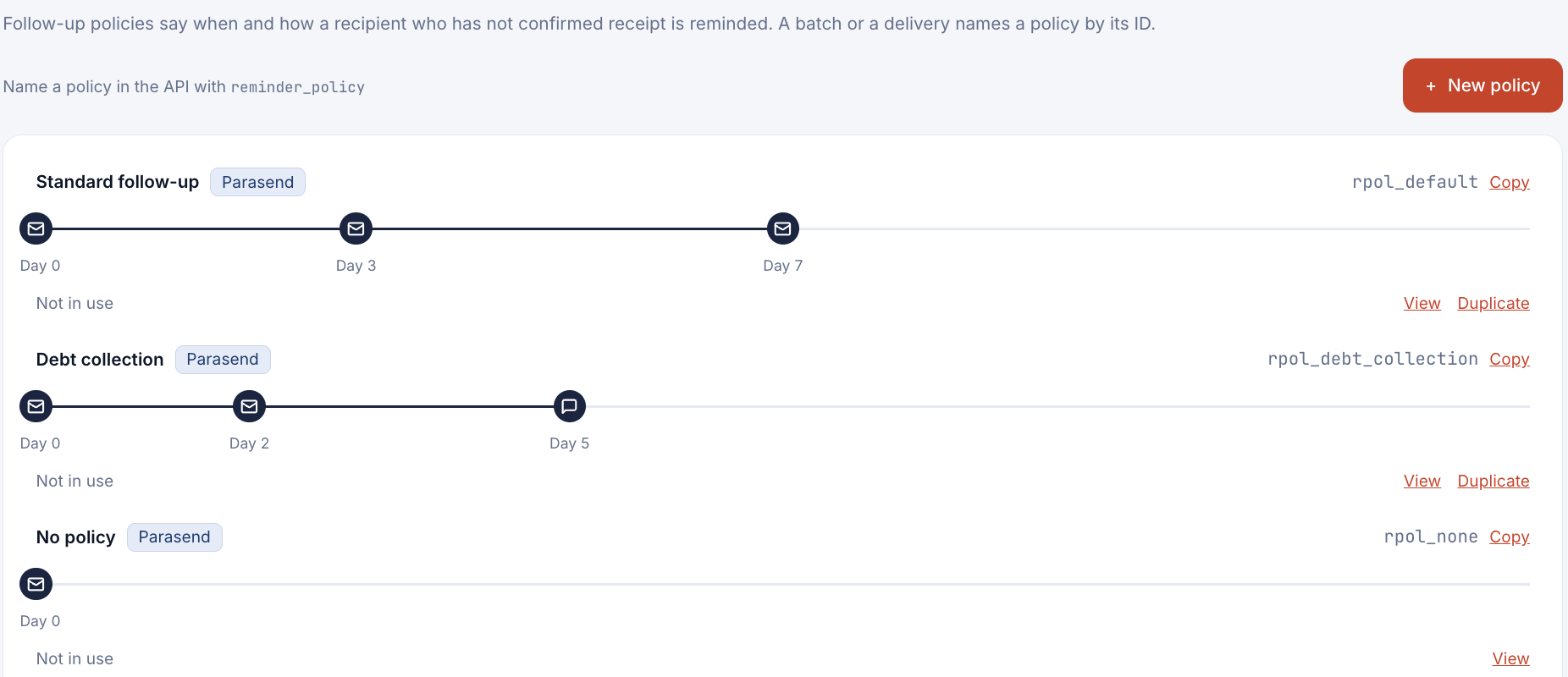
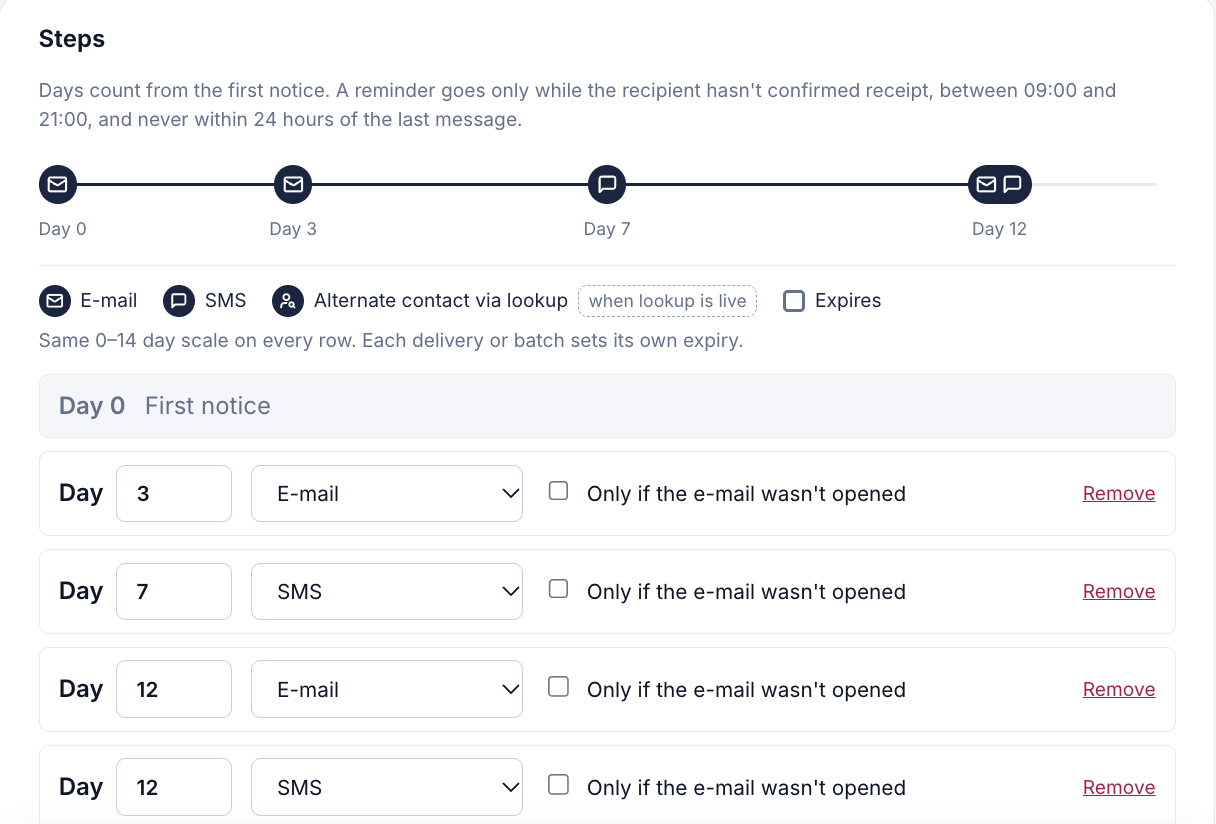
Batches and single deliveries can both use a follow-up policy, which sends reminders automatically until the recipient confirms: by e-mail, and by SMS when you have their phone number.
You set the cadence and channels when creating a delivery or batch, in the portal or via the API; a typical schedule reminds after 24 hours, then 3 days, then 7 days. Reminders stop the moment the recipient verifies and accepts receipt. A delivery is billed once, when it is sent; e-mail reminders are included, and SMS reminders cost the SMS price.
If a delivery goes unopened, a lookup can show whether the recipient has saved a newer consented channel in the Parasend network, so the next reminder goes somewhere they actually read. The Lookup service is coming soon.
Which eID methods does each Nordic country support?
Parasend's verification covers all five countries through their national scheme, routed automatically - you don't choose a method per country yourself.
- Iceland - Auðkenni, mobile & SIM-based eID.
- Norway - BankID, bank-issued, mobile-first.
- Sweden - BankID, bank-issued, near-universal smartphone adoption.
- Denmark - MitID, the state-run successor to NemID.
- Finland - Suomi.fi / FTN, bank-issued credentials via the Suomi.fi identification broker.
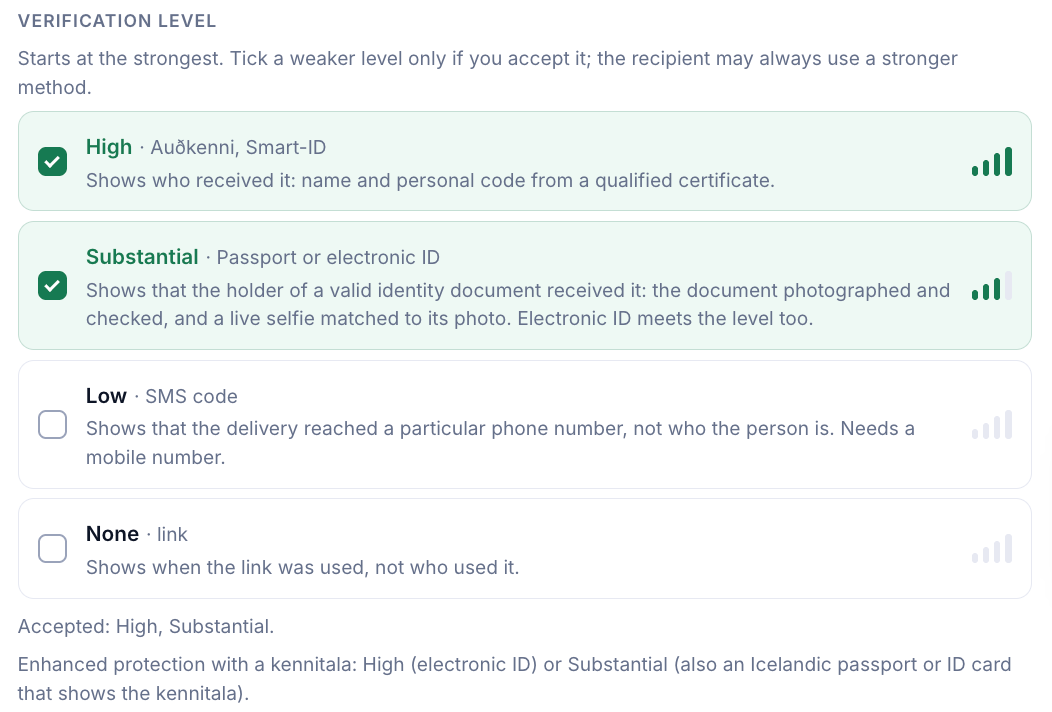
Outside these five, or if a recipient can't reach their national eID, Parasend falls back to passport-and-video verification, available in 180+ countries - so a delivery is never blocked on one identity scheme. See Verification levels on the Product page for how each method maps to an assurance level.
How secret deliveries protect sensitive content before the recipient verifies
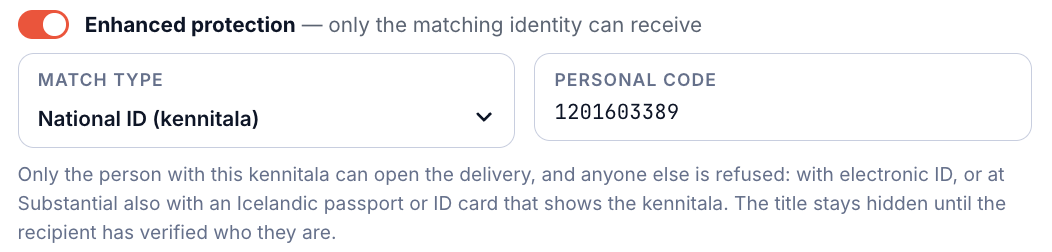
A secret delivery keeps the document itself encrypted and inaccessible until the recipient completes identity verification - they see only that a delivery is waiting, not its contents or sender, until they confirm who they are. This matters for HR matters, workplace investigations, or pre-litigation correspondence, where you need proof the right person saw it, but don't want the content exposed to anyone else who might have access to their inbox or phone.
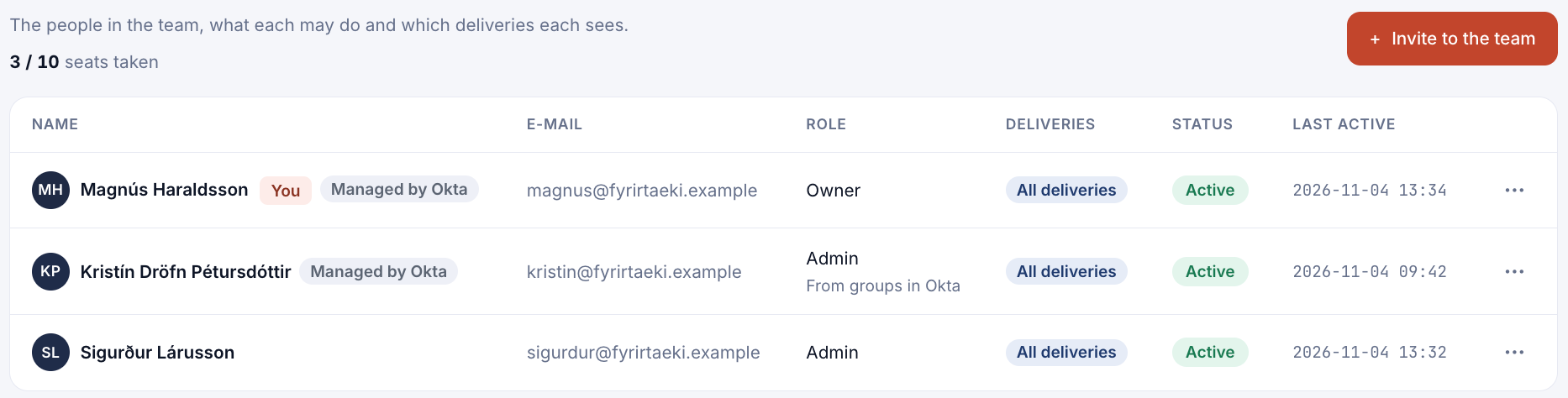
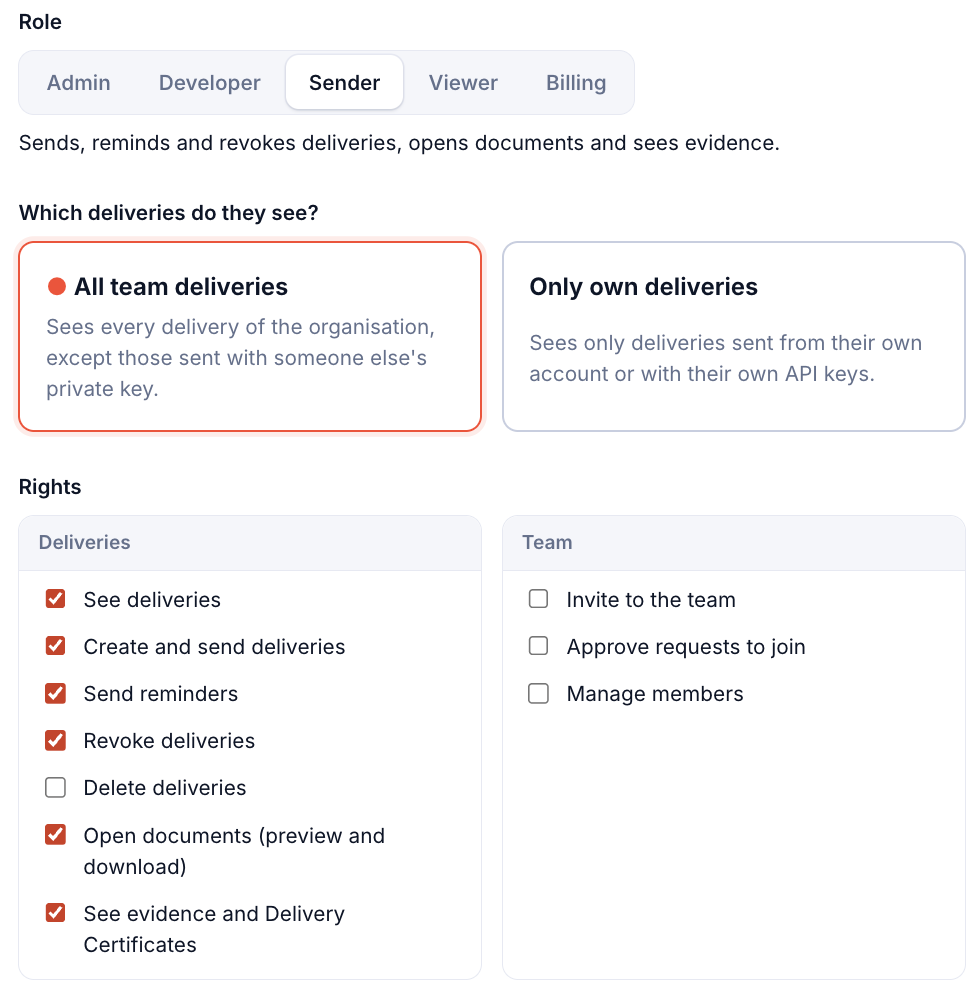
On your side, secret deliveries can be scoped to specific team members, so sensitive matters aren't visible across your whole organisation by default.
Secret deliveries use the same evidence and follow-up engine as any other delivery - the only difference is what's visible before verification succeeds.
Pricing: free deliveries, plans, Enterprise and extras
Start free: companies get 20 free deliveries and individuals 3, once and without a card, with full evidence, eID verification and SMS.
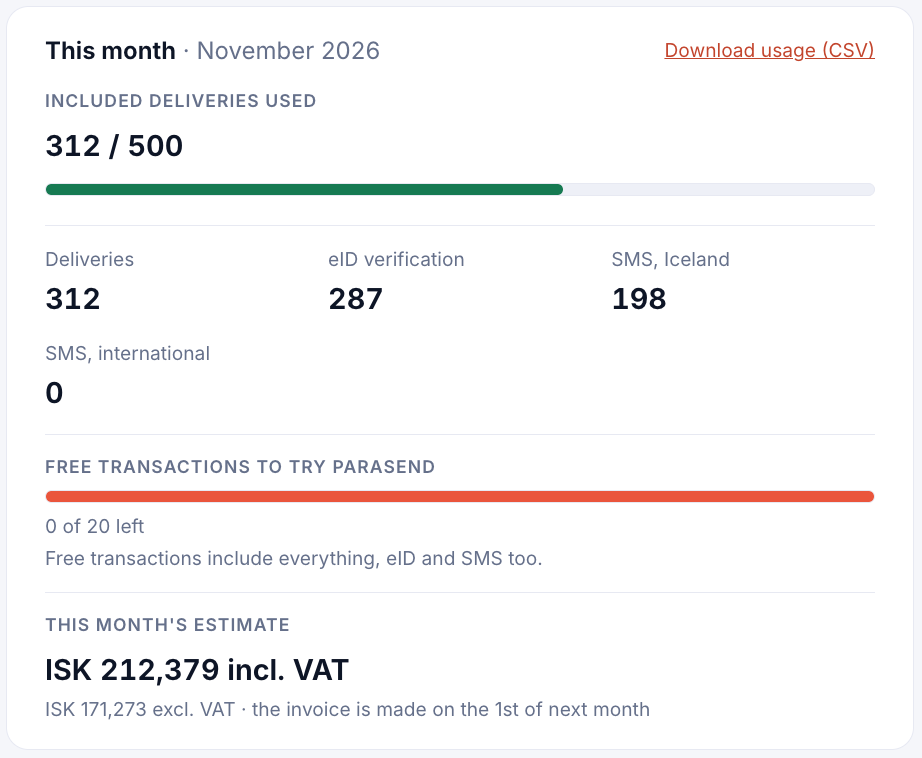
Pay-as-you-go: 311 kr per delivery, with no monthly fee and no commitment. Plan 1–3: 500, 1,000 or 5,000 deliveries a month at 287, 263 or 240 kr; extra deliveries are charged at the same rate.
Each delivery is billed when it is sent. Deliveries that bounce, or are cancelled before the first notice, are not billed. A secret delivery costs 39 kr. A document request costs the same as a delivery and is billed at the first upload.
Extras are billed separately: eID verification 29 kr per party and SMS 25 kr per message in Iceland. The portal, API and webhooks come with every plan. Enterprise is an agreement with a platform fee and committed volume, above 5,000 deliveries a month. See Pricing.
Generating and rotating API keys
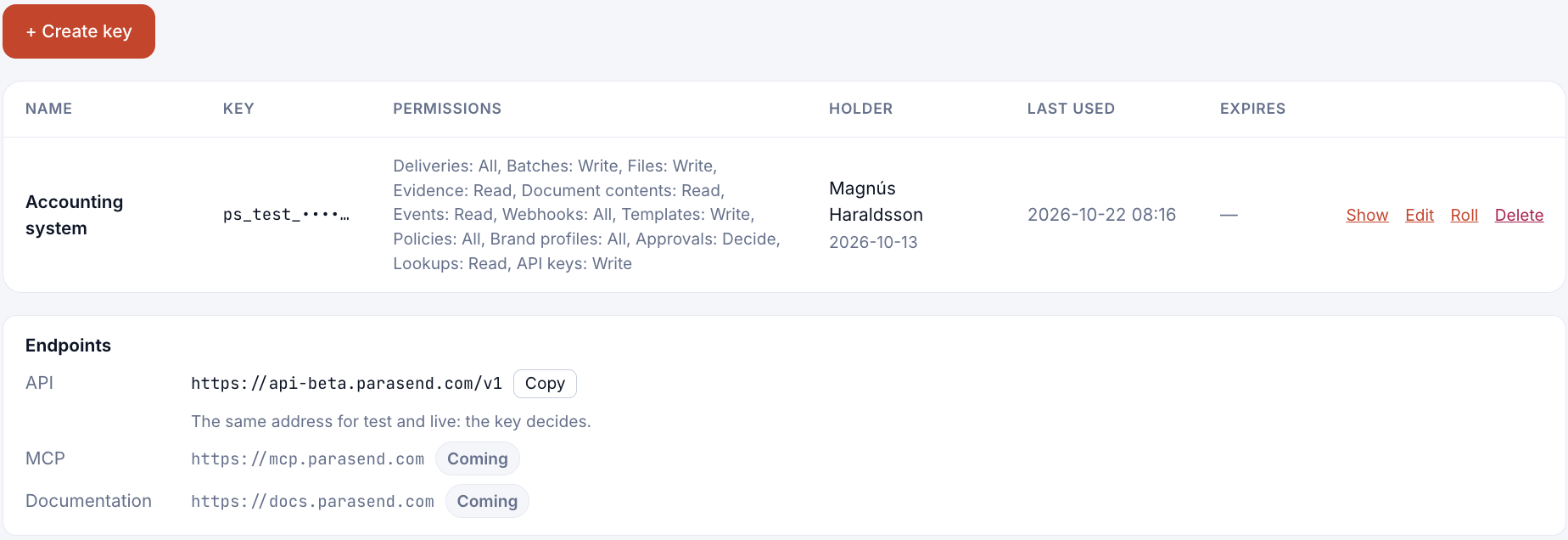
Keys are made in the portal, under API keys, by a person signed in with eID; an API key cannot make or change keys. Start with a test key (ps_test_…): test mode sends nothing, bills nothing, and uses the same address as live mode. Make a live key (ps_live_…) when you are ready to send for real.
Keys belong to your organisation and have only the permissions you give them - for example a key that can create deliveries but not read evidence. A key can also be limited to its holder's own deliveries, and given an expiry date, a monthly cap and an IP allowlist. Roll a key in the portal when it may have leaked, or on a schedule: the new secret works at once and the old one keeps working for 24 hours, so you can switch without downtime.
Treat live keys like any other production credential: keep them in your secret store, never in code, logs or a URL, and roll them if you suspect exposure.
Read Authentication in the API docs →
How do I recognise a genuine Parasend delivery?
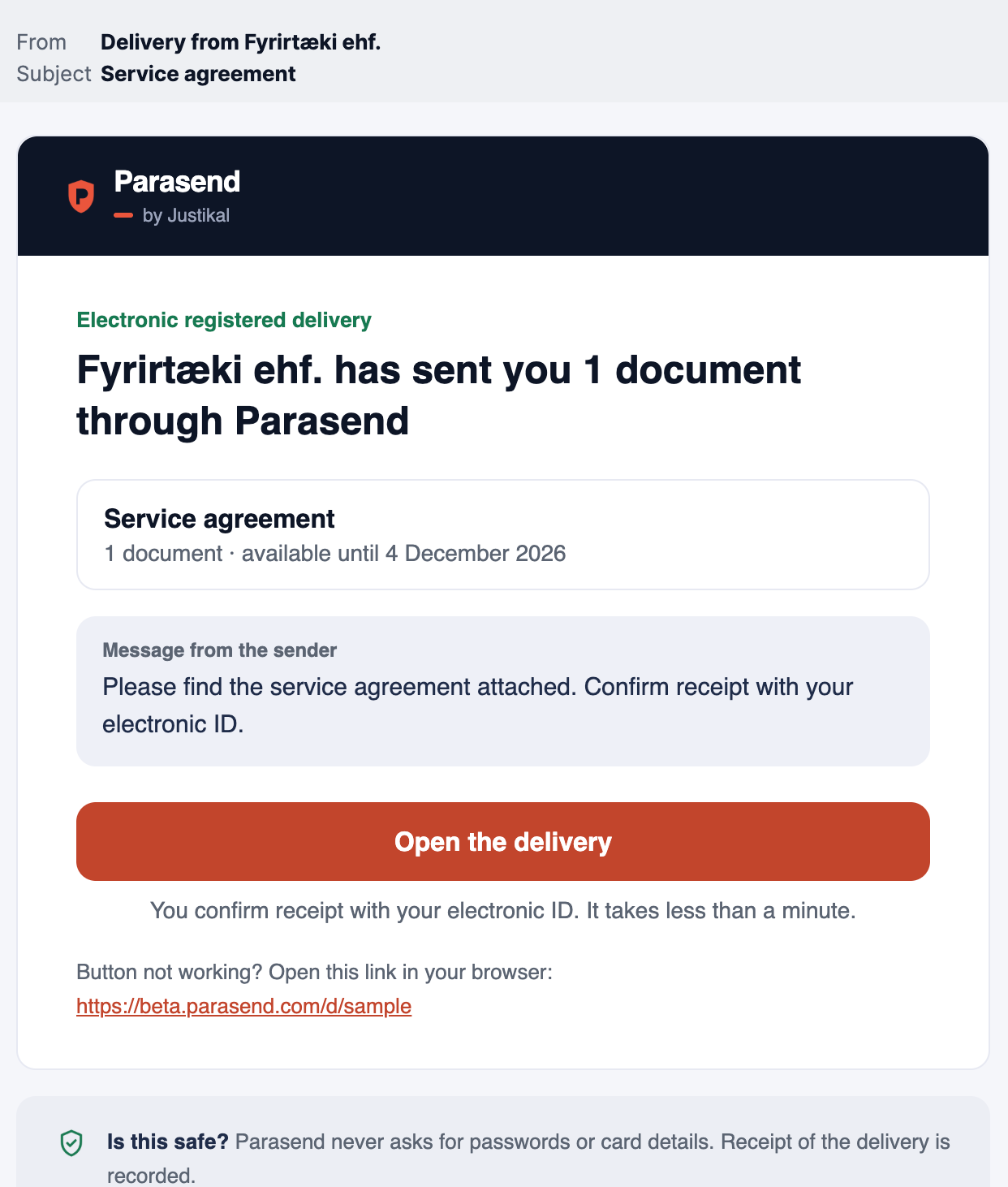
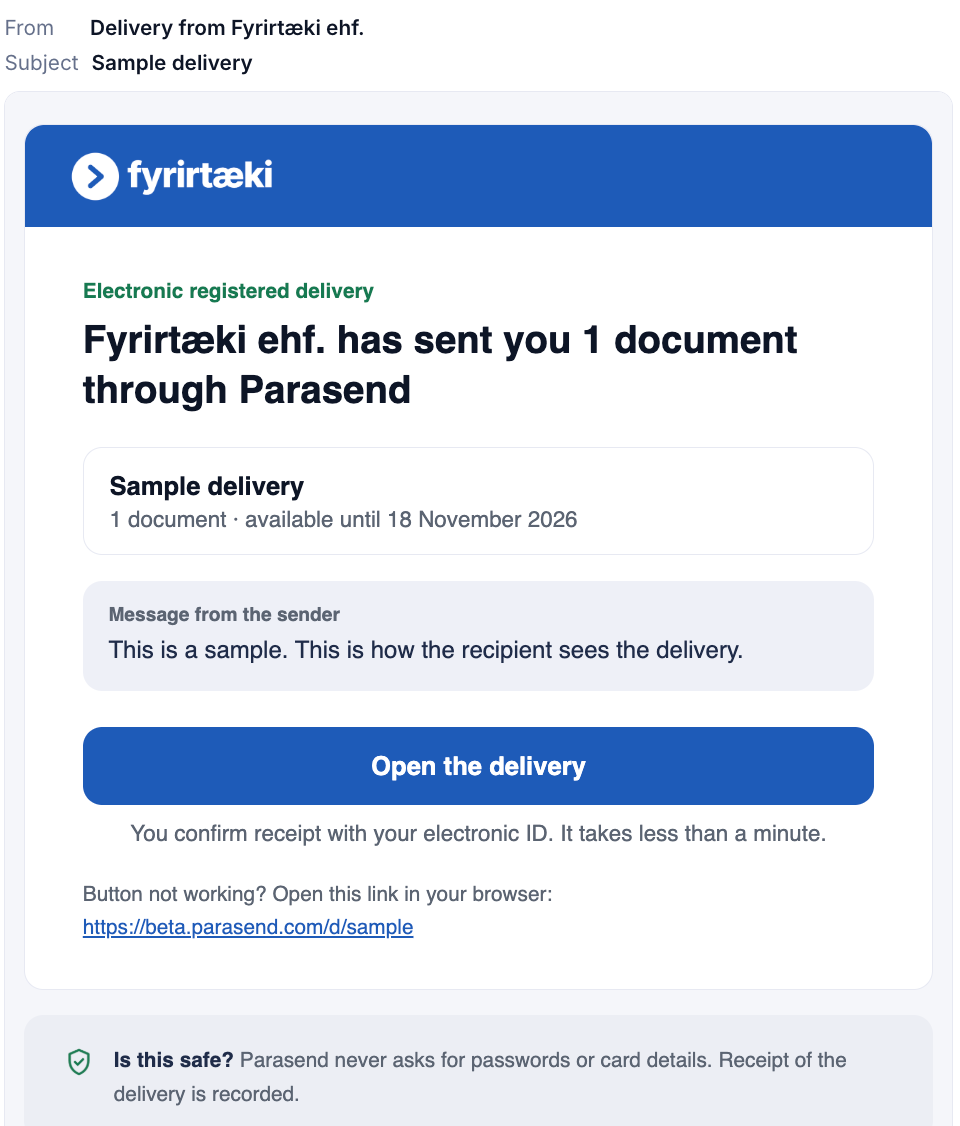
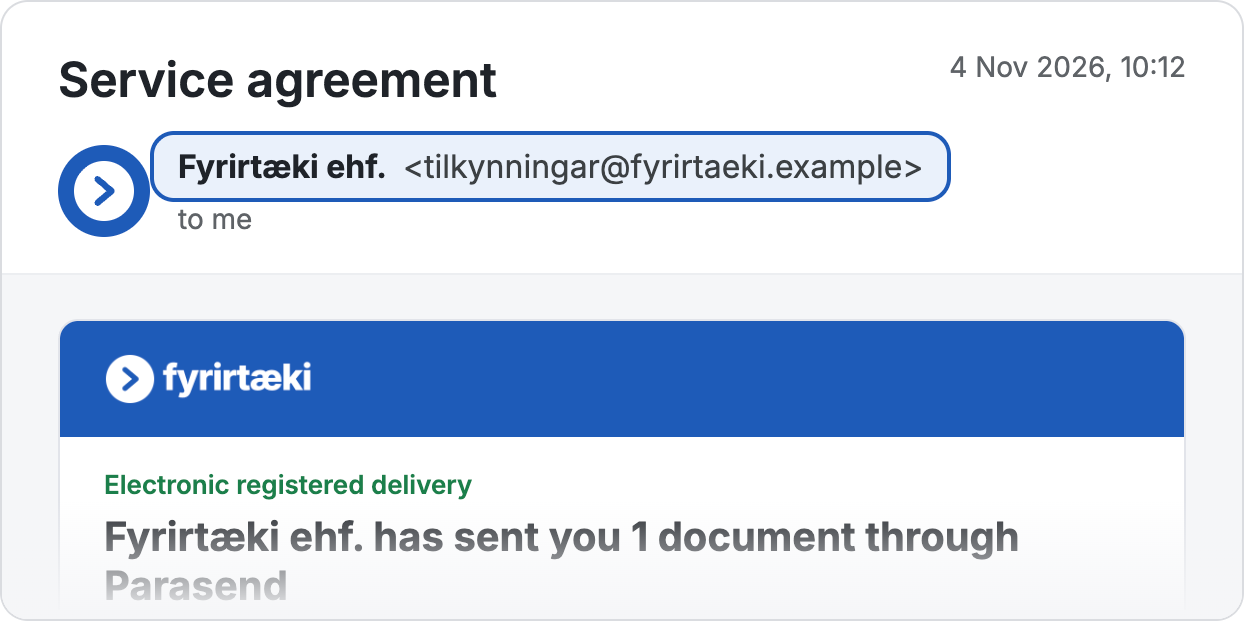
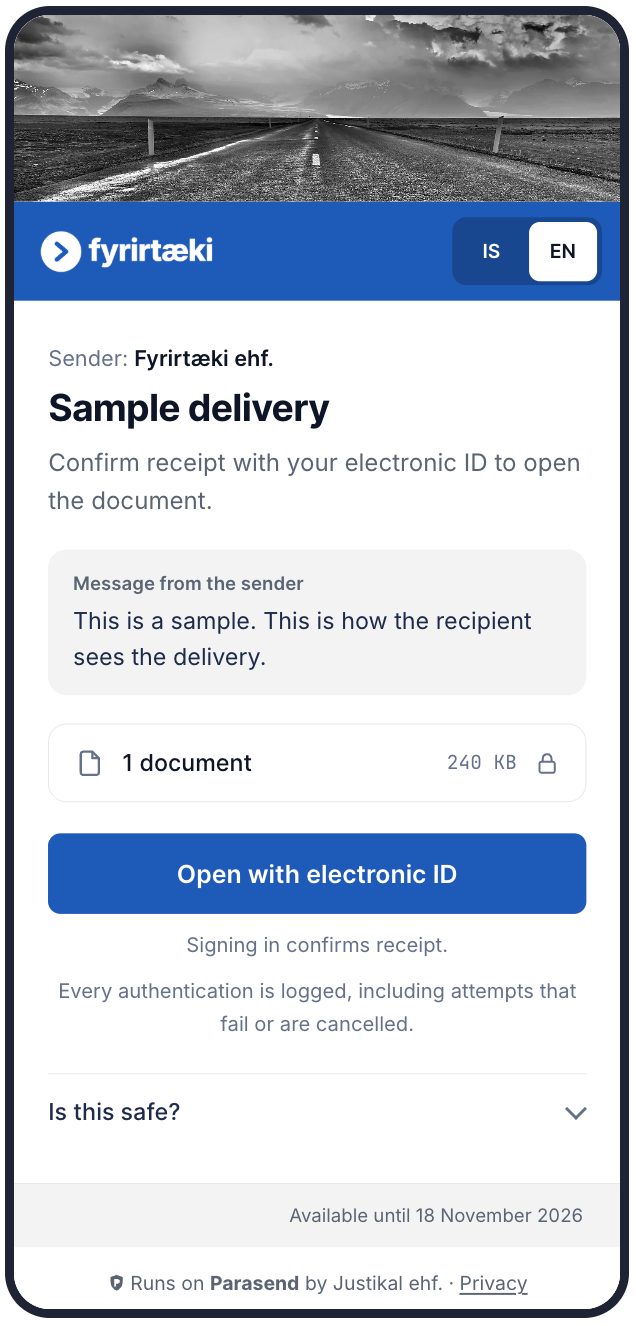
A Parasend notification contains a link to the delivery's own page. The link only opens a delivery that is live - a link that doesn't point to a live delivery opens nothing.
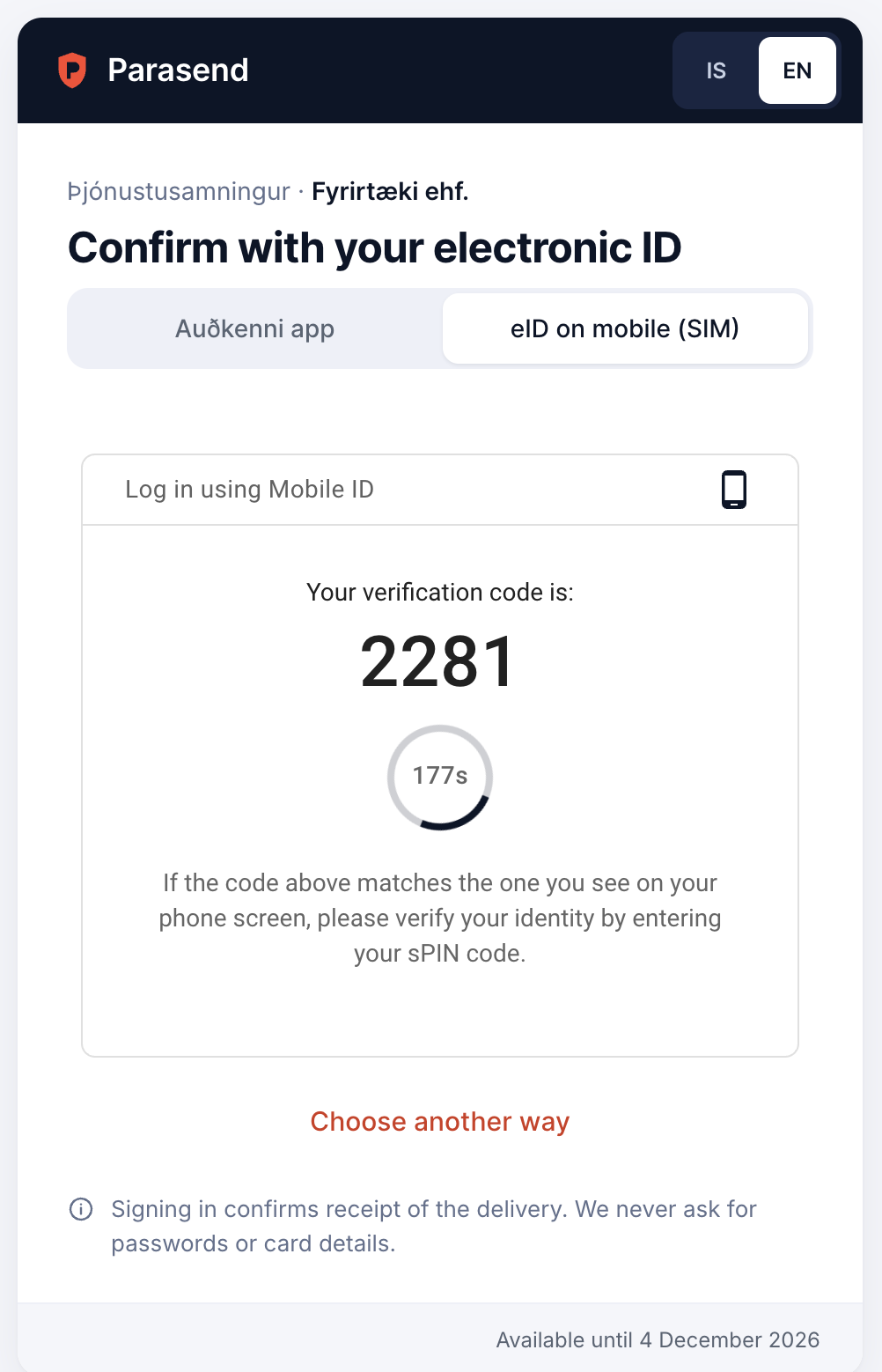
Parasend never asks for card details, a payment, or the password to your online bank or email. When verification is required, you confirm with national eID, such as Auðkenni or Smart-ID, by approving the request in your own eID app or on your own phone.
If in doubt, don't open the link. Contact the sender another way, or write to us at info@parasend.com.
How to log in to Parasend
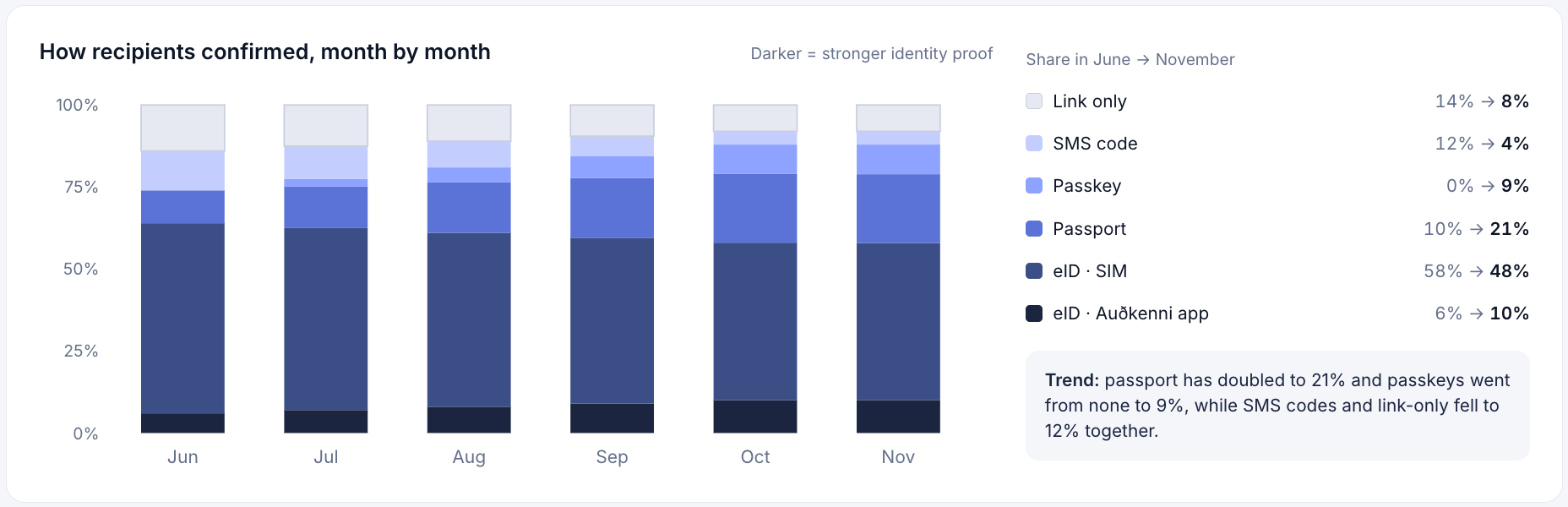
Parasend doesn't use passwords. The first time you send or receive a delivery, you verify your identity directly - with the Auðkenni app, Auðkenni SIM (enter your phone number), Smart-ID for Estonia, Latvia and Lithuania, or a passport with video verification for 180+ other countries. That single verification does two things at once: it confirms who you are, and it creates your Parasend workspace - your deliveries, evidence records and receipts all live under that verified identity from then on.
On return visits, Parasend offers a passkey (Face ID or Touch ID) instead, remembered on that device only. A passkey carries the same eID-grade assurance as the Auðkenni verification that created it - it's not a weaker shortcut, just a faster one. If you're on a new device, don't have your passkey, or want to switch identity ("Not you?"), you can always fall back to Auðkenni, Smart-ID or passport verification; your account isn't tied to a single device.
See verification levels on the Product page for how each method maps to an assurance level.
How to change your email address in Parasend
Your Parasend identity is your verified eID, not an email address or password - so changing your email never affects how you log in. Email and phone are contact channels: where Parasend sends notifications, receipts and billing correspondence, nothing more.
Update the email on file for your account from your account settings, the same way you'd update a phone number - enter the new address and confirm it via the verification link Parasend sends, the same pattern used when you registered your phone number during identity verification.
For anything tied to a subject access or data request on a specific address, contact privacy@parasend.com.
What is an audit log?
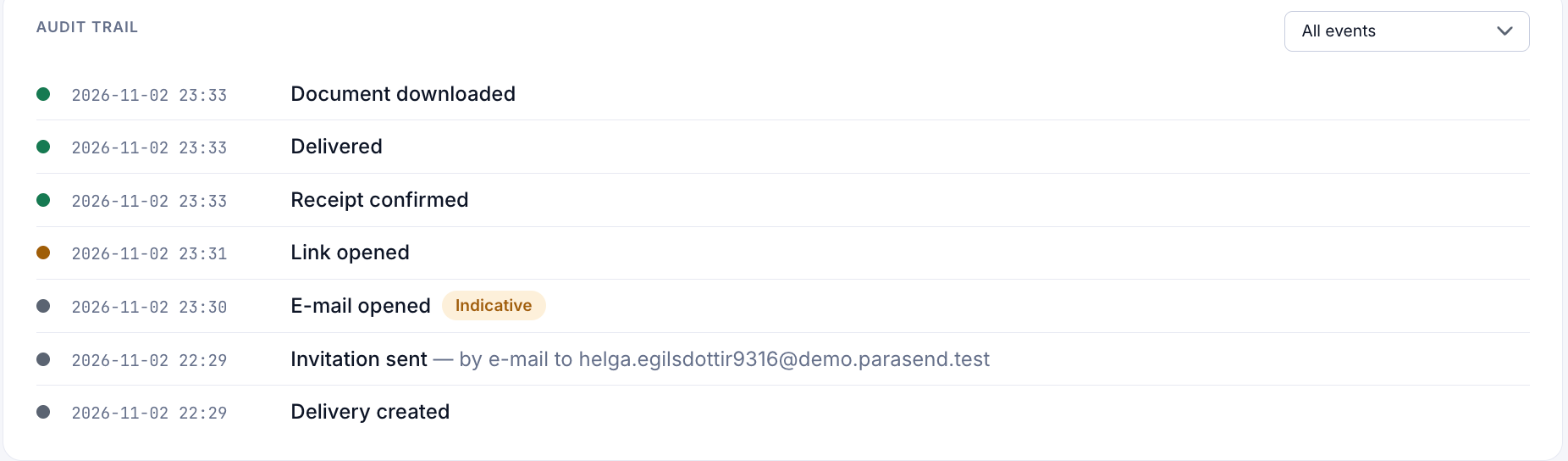
Every delivery on Parasend carries a full event timeline from creation through to delivery: when it was sent, when the recipient opened the verification link, which method they used to confirm identity, and the exact moment they accepted receipt. That timeline is the audit log for a single delivery - and it's exactly what gets sealed into the evidence pack once the delivery reaches its final state. The audit trail and the legal evidence aren't two separate systems; one is built directly from the other.
Account-level actions are logged the same way: who sent a delivery, who revoked one, who changed a setting or removed a teammate - each entry records the acting person's verified identity, not just "someone on the account."
Review a delivery's full timeline from its detail view in the portal, or retrieve it via the API (GET /v1/deliveries/:id/events). See the Developers page for the full API reference.
What is an electronic seal, and why does every delivery get one?
An electronic seal is what makes Parasend's evidence trustworthy without anyone having to take our word for it. Once a delivery reaches its final state, Parasend hashes the exact document that was delivered and locks it with an electronic seal through a trust service provider on the EU Trusted List, with the time taken from a synchronised UTC clock. Any later edit or substitution, in either direction, becomes detectable.
This is the integrity leg of what registered-delivery evidence has to establish under eIDAS Article 43, alongside verified identity, accurate timing, and independent supervision - Parasend operates as a registered postal service provider under lög nr. 98/2019, supervised by Fjarskiptastofa the same way traditional registered mail is. Evidence records follow the ETSI EN 319 522 standard.
See What we hold ourselves to for exactly what's certified today, and DPA & legal for the full legal basis.
How to delete your account in Parasend
Account data can be exported or deleted within 30 days of a request, unless it's subject to an active legal hold or ongoing dispute - in which case deletion is deferred until that clears. To start either one, contact info@parasend.com, or for anything tied specifically to personal data, privacy@parasend.com.
Deleting your account and deleting a single delivery aren't the same thing - a delivery can be removed on its own at any time, while deleting an account removes everything tied to it going forward.
Either way, sealed evidence of deliveries that already completed is retained for the period set by your plan, or a custom period on Enterprise - that's a legal requirement, not a Parasend choice, since proof of something that already legally happened can't be erased. See Retention & your rights on the DPA & legal page for the full policy.